
Understanding Bat Speed: How Early Spring Data Can Shape Our Expectations for 2025

What if I told you that after just six swings, we could predict a player’s bat speed for the entire season? Sounds too good to be true? Let’s dive into how data from Spring Training is changing the way we think about bat speed and player performance.
Before we get ahead of ourselves, it's worth revisiting how bat speed stabilizes over time, particularly during the 2024 season. While it’s tempting to assume that bat speed can fluctuate wildly from swing to swing, the reality is that it stabilizes relatively quickly. In fact, it doesn’t take much to reach a point where we can confidently assess a player’s bat speed—specifically, the median bat speed. From our analysis, it typically takes about 5-6 swings to establish a reliable baseline for a player’s bat speed, offering us a solid foundation to predict their performance moving forward. The key here is consistency; once we have that initial set of swings, the data starts to show us a clear picture of what a player's bat speed is likely to be over the course of the season.
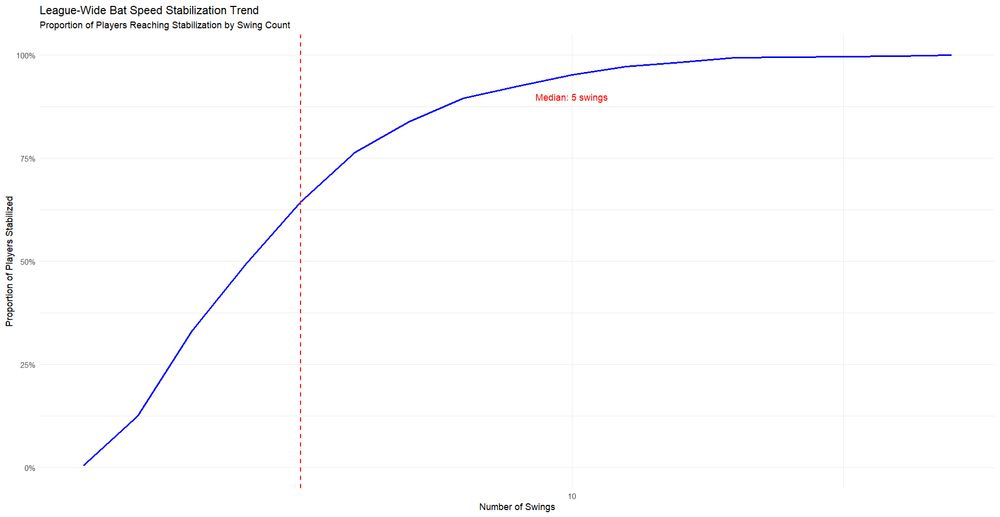
As we analyze bat speed data over time, a clear pattern emerges. By the time a player has taken approximately 10 swings, we’re very close to 100% stabilization—meaning that after 10 swings, we can confidently say the player’s bat speed has essentially stabilized for the season. In other words, it rarely takes more than 10 swings to fully establish a player's bat speed, with little to no significant fluctuation expected beyond that point.
However, it’s worth noting that even at the 5-6 swing mark, we’ve already achieved stabilization for roughly 50-60% of players across the league. This is a crucial insight, as it tells us that a significant portion of players begin to reveal a reliable baseline in just a handful of swings.
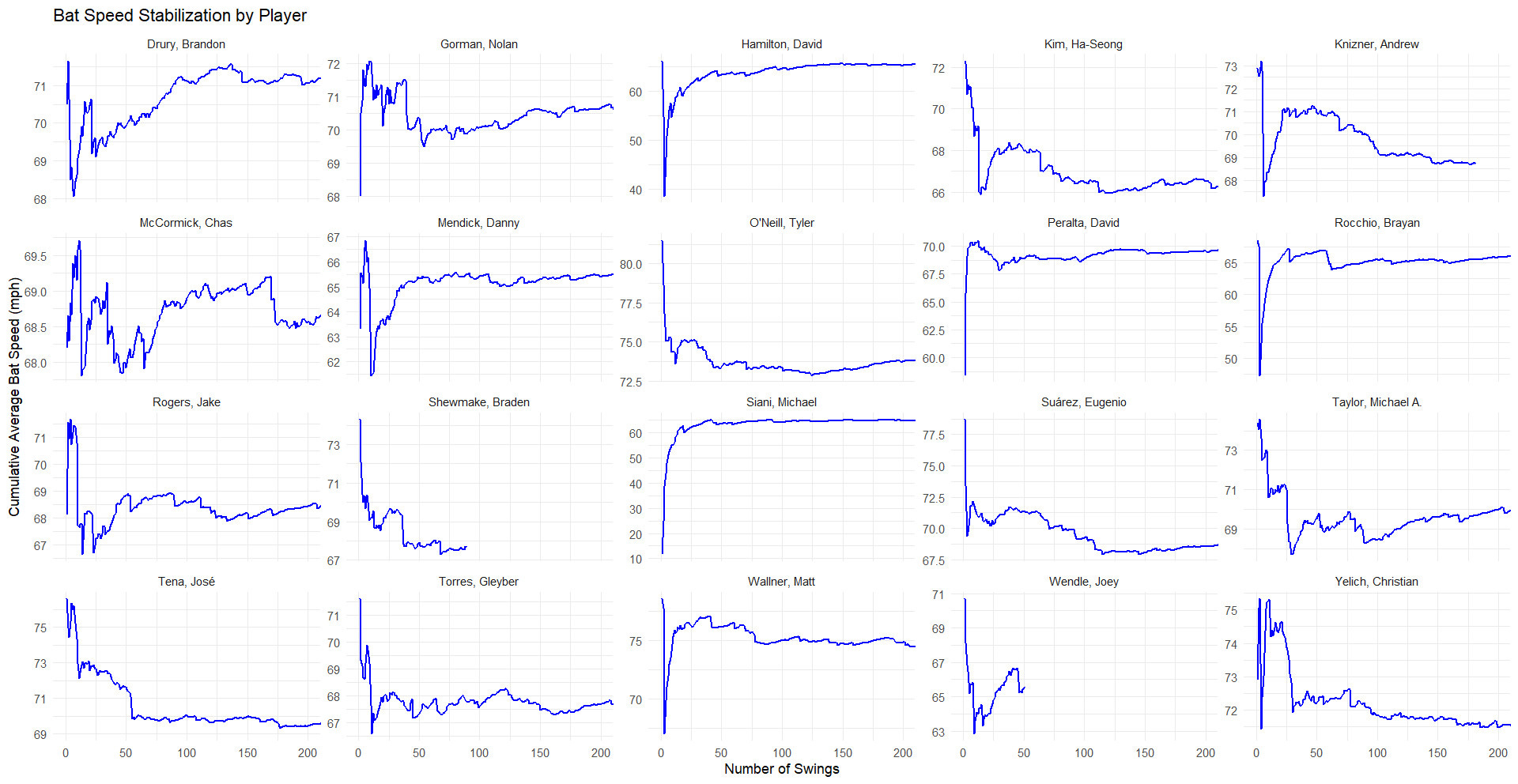
For most players, anything beyond 10 swings doesn’t offer much additional value in terms of tracking bat speed stability. Beyond that point, the numbers tend to plateau, and we can be confident that the bat speed we see in these early swings is representative of what we can expect throughout the season. This allows us to not only track bat speed early on but also to start predicting a player’s performance with greater accuracy much sooner than initially expected. We see this below from a sample of players:
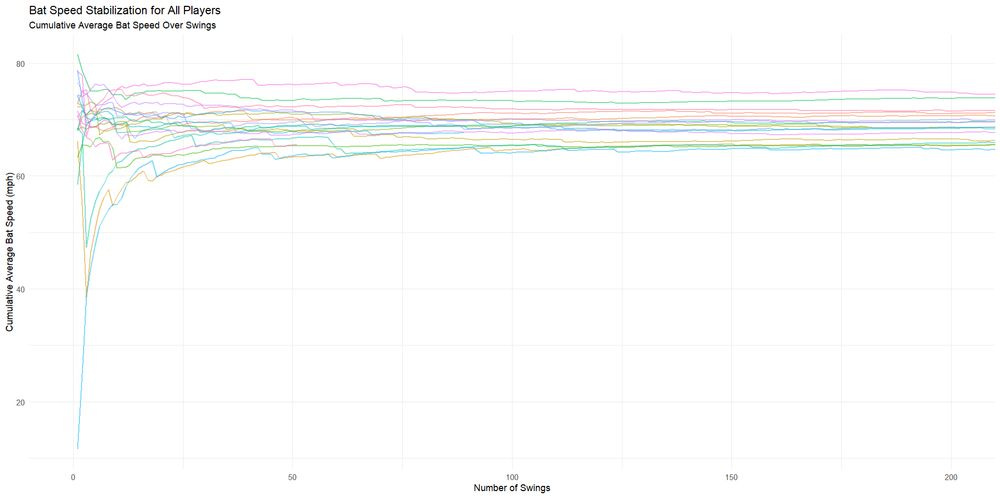
When examining the individual player graphics, it’s clear that there’s significant variability at the beginning. Early on, bat speed readings can be quite erratic, with players showing wild fluctuations from swing to swing. This initial volatility is not uncommon, as players are still settling into their rhythm, adjusting to the conditions, and fine-tuning their mechanics. However, as they progress through their swings, the data begins to stabilize. Over the next few swings, we see a marked trend toward consistency, with the fluctuations becoming less pronounced and more predictable.
While some players may experience movement in different directions—whether up or down—these shifts are typically short-lived. For the most part, players’ bat speeds tend to find a steady range and remain there, offering a reliable baseline for their performance. This pattern is important for evaluating player potential and understanding how they are likely to perform as the season progresses. Early inconsistencies are generally smoothed out quickly, and players tend to settle into their true bat speed over a relatively short period. This allows for more confident projections based on a stable set of data that can be relied upon as we move forward in the season.
With 112 players already having accumulated over six swings through Baseball Savant this Spring, we now have a substantial sample size to start making more informed assumptions about a player's bat speed as the season kicks off. Given that we’ve seen how quickly bat speed tends to stabilize—especially with just 5-6 swings—we can confidently begin to draw conclusions about players' capabilities heading into 2025.
Players who have surpassed this threshold are especially valuable for analysis, as their bat speed numbers have likely stabilized enough to offer meaningful insights. At this point, we can begin to discern trends and identify any signs of improvement or decline. These early bat speed readings give us a glimpse into a player’s current physical state, their swing mechanics, and overall bat-to-ball ability.
Importantly, these bat speed metrics are predictive in nature, offering us a clearer picture of what players might be capable of in the upcoming season. A player who shows significant improvement in bat speed may be on the verge of a breakout season, while those showing a decline might be facing challenges in their swing mechanics or physical performance.
By focusing on the players who have surpassed six swings, we have a solid foundation of data to guide our predictions and evaluations. With this initial data in hand, we’re not just guessing about a player’s potential; we’re using measurable, stabilized bat speed numbers to form more accurate expectations for their performance in 2025.
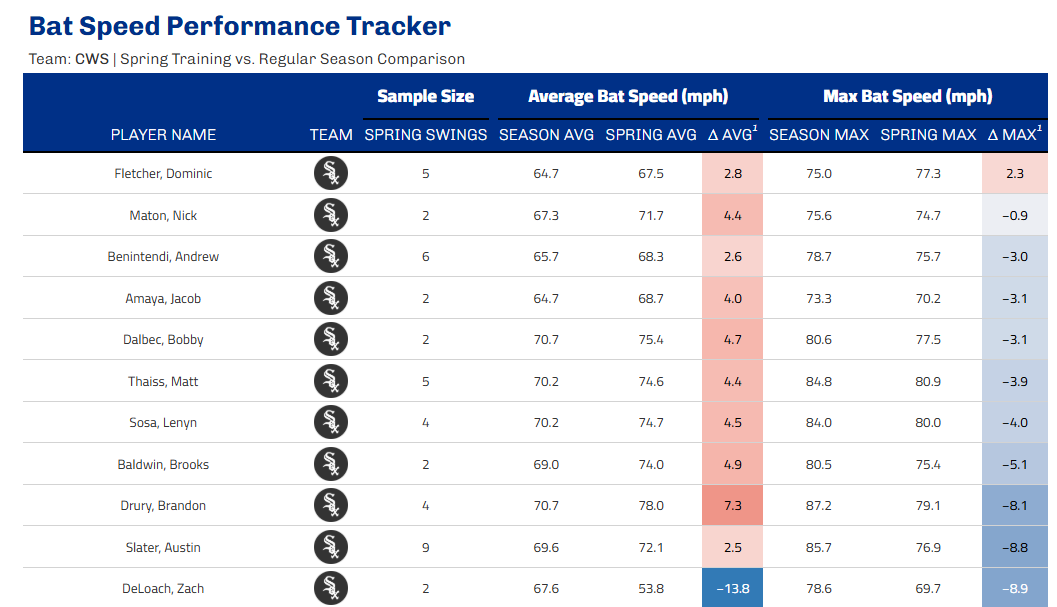
I’ve created a Spring Training Bat Speed App that allows you to go in and see which players have moved the needle in either direction when it comes to bat speed so far in Spring Training. Pretty easy to work with, pick a team and their players who have bat speeds from last season, and this season allow you to compare between potential changes.
For the full data and in-depth insights, check it out below. Make sure to subscribe to stay ahead of the game and receive ongoing updates throughout the 2025 season—don’t miss out on exclusive, actionable analysis that could give you the edge in evaluating player performance and forecasting breakout seasons.
By subscribing, you’ll get real-time updates, detailed player breakdowns, and the kind of predictive insights that could transform the way you evaluate players all season long. Stay informed and ahead of the curve—your 2025 season starts now!
Nice write up!!